Sunday, 15 February 2015

The Great London Literary Bench Hunt Part 3

Dear Reader, I have held you in abeyance for too long.  Now, I must recount my hunt for the remaining benches during August and September last year.

On the 8th August 2014, I hit the London Bridge and Southbank area to find as many of the benches as I could.


Great Expectations (Bench 24 - 8th August 2014)


The front of the bench depicting gaslight lit streets and towards the bottom half of the bench doomed to be sat on is the convict, Magwitch.  The bench was located not far from Borough Market.  

The back of the bench illustrates a riverside scene.

Please Look After This Bear. Thank You. (Bench 25 - 8th August 2014)


Poor Paddington Bear on his own with his beloved marmalade at Paddington Station.  This is the front of the bench that was located next to the Great Expectations bench.  I was surprised how often the benches could be found in close proximity to each other.


The back of the bench is actually quite sad.  The lone Paddington Bear sits alone sharing his food with the pigeons whilst he sees people in the distance.  How many people are honest enough to admitting to having days when they have felt this alone?

From The Gruffalo to Scarecrows: The World of Axel Scheffler and Julia Donaldson (Bench 26 - 8th August 2014)


The front of the bench which was located near to London City Hall.  The only one of the benches, which had a fence around it.  The bench includes characters from the worlds created by Axel Scheffler and Julia Donaldson.  


The back of the bench featuring such delightful elements as a loving Scarecrow couple, a goat and a pig.

The Librarian - Discworld (Bench 27 - 8th August 2014)


The front of the bench depicting a character from Terry Prachett's 'Discworld' novels.  It was located in More London (the area near the City Hall).


The back of the bench revealing the Discworld in all its glory.

Clarice Bean (Bench 28 - 8th August 2014)


This was quite a popular bench in the More London area again (as you can see from the legs behind it).  Clarice's comment is very true though, there are times when you want to start again upon finishing a good book.


The back of the bench with another of Clarice Bean's wise sayings.  I didn't know her beforehand but now I feel like an acolyte, sharing her sayings with the world.

How to Train Your Dragon (Bench 29 - 8th August 2014)


The front of the bench located in More London depicted a big blue dragon and the wild sea.


The back of the bench upon which a red dragon can be seen flying.

The World Of Dr. Seuss (Bench 30 - 8th August 2014)


This bench was located in More London.  I really liked how vibrant and colourful the bench was.  All of Dr. Seuss' most well known characters are depicted including The Cat in the Hat.


The back of the bench contains images of the book covers.  Definitely, one of my favourites of the benches.

Through The Looking Glass (Bench 31 - 8th August 2014)


This bench was also located in More London and was an absolute nightmare to photograph.  A woman had made herself very comfortable on this bench and I had to politely ask her to move, so that I could take a quick photograph and she gave me a filthy look before moving.  I felt a bit rotten because the moment she shifted everyone ran to take photos of the bench.  The utter surrealism of the novels is captured magnificently by the artist.  The bizarre chess board image mirrors a scene in one of the novels if I am not mistaken.


The back of the bench was slightly less interesting, although not easy to photograph.

Remember how I couldn't find three of the Greenwich Park benches?  Well, on my Mum's birthday, my Mum, sister and I went traipsing around the park in hunt of the little darlings.  My sister's sense of direction being far more useful than my own.

Elmer The Patchwork Elephant (Bench 32 - 23rd August 2014)


The front of the bench was covered with multiple images of linked elephants.  The only one that is different can be seen at the bottom right of the bench as it is black and white.  I suspect that this bench is a celebration of individuality as this tends to be the message perpetuated by many children's books.


The back of the bench is a patchwork of coloured squares.

The Time Machine (Bench 33 - 23rd August 2014)


The front of the bench, which was located near to the Royal Observatory in Greenwich Park.  Another bench, which required my Mum this time to politely ask the guardians of the bench to shift, so that about eight separate people could take photos of it.  Marvel at the detail of the time machine and remember how much you enjoyed reading the H.G. Wells' novel.


The back of the bench featuring all of the sophisticated equipment that you would need to travel through time.  Remember the novel was written prior to the days of the ZX 81!

We're Going On A Bear Hunt (Bench 34 - 23rd August 2015)


The front of the bench located near to a pond in Greenwich Park, which was clearly intended owing to the image on here of a bunch of kids looking down into a pond.


The back of the bench featuring a large hill and a dog in the grass at the bottom right.  This bench also required some tactful negotiation with the occupiers, so that the bench could be photographed.  

The next leg of the bench hunt took me over to the Bloomsbury area of London and around that neck of the woods on the 30th August 2015.

James Bond (Bench 35 - 30th August 2014)


This bench was located in Bloomsbury Square Gardens.  The artist has cleverly incorporated details form the James Bond novels such as the man himself drinking Martini and references to gambling.


The back of the bench plays on the voodoo elements that feature in some of the Bond novels such as 'Live and Let Die'.

The Agatha Christie BookBench. Also known as Hercule Poirot and the Greenshore Folly (Bench 36 - 30th August 2014)


This bench was located in Bloomsbury Square Gardens and incorporates elements from the novella 'Hercule Poirot and the Greenshore Folly', which was later expanded to become 'Dead Man's Folly'.  Agatha Christie filled both stories with aspects of her own life and the region where she lived.


The back of the bench and a very striking female face.  I love the use of flowers and butterflies on this bench.  This is another of my favourite benches.

"Always try to be a little kinder than is necessary" - Peter Pan (Bench 37 - 30th August 2014)


This bench was located in Red Lion Square Gardens and was the second of the Book Benches to be based upon 'Peter Pan'.  I hope that I regularly try to live by the above proverb.  Kindness is important.  Lots of elements from 'Peter Pan' appear on this bench.


The back of the bench featuring Captain Hook's ship and various underwater elements including a particularly fetching mermaid.

Pride and Prejudice (Bench 38 - 30th August 2014)
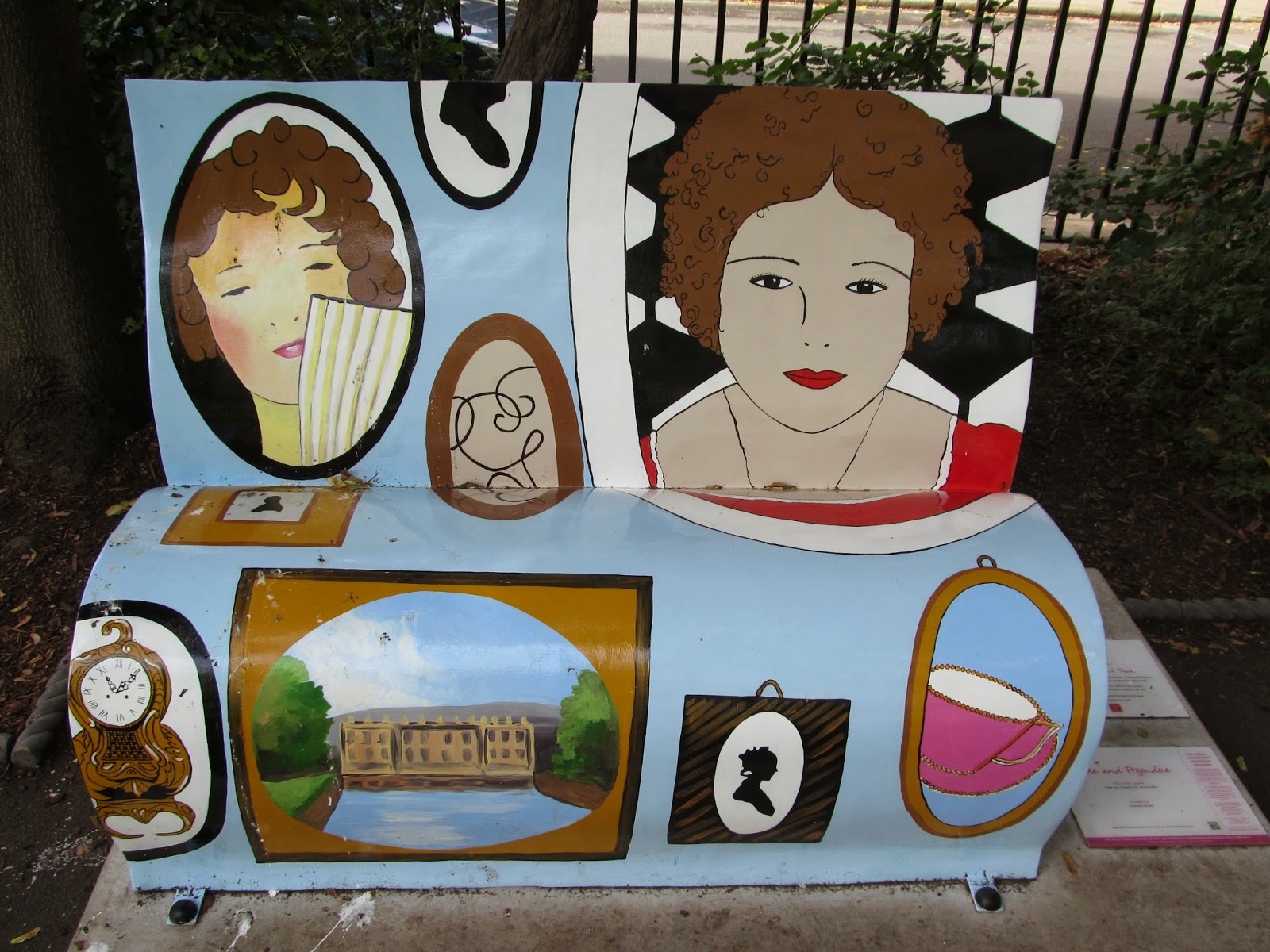

This bench was located in Queen Square Park and Garden.  The front of the bench reveals lots of elements from Jane Austin's novels.  Alternatively, it can be seen as a series of cliches surrounding the upper classes depending upon whether you like Jane Austin.


The back of the bench again containing elements from the novel.  A slightly awkward photo on account of the bench's position, which I believe may have been next to a fence.  This was one of the recurring problems with taking photos of some of the benches (they were too close to walls or fences).

Rest Your Stalks - The Day of the Triffids (Bench 39 - 30th August 2014)


The front of the bench which was located near to Senate House featuring the ever lovely Triffids and the literally blinding celestial bodies that helped to make the stupid human race their victims.
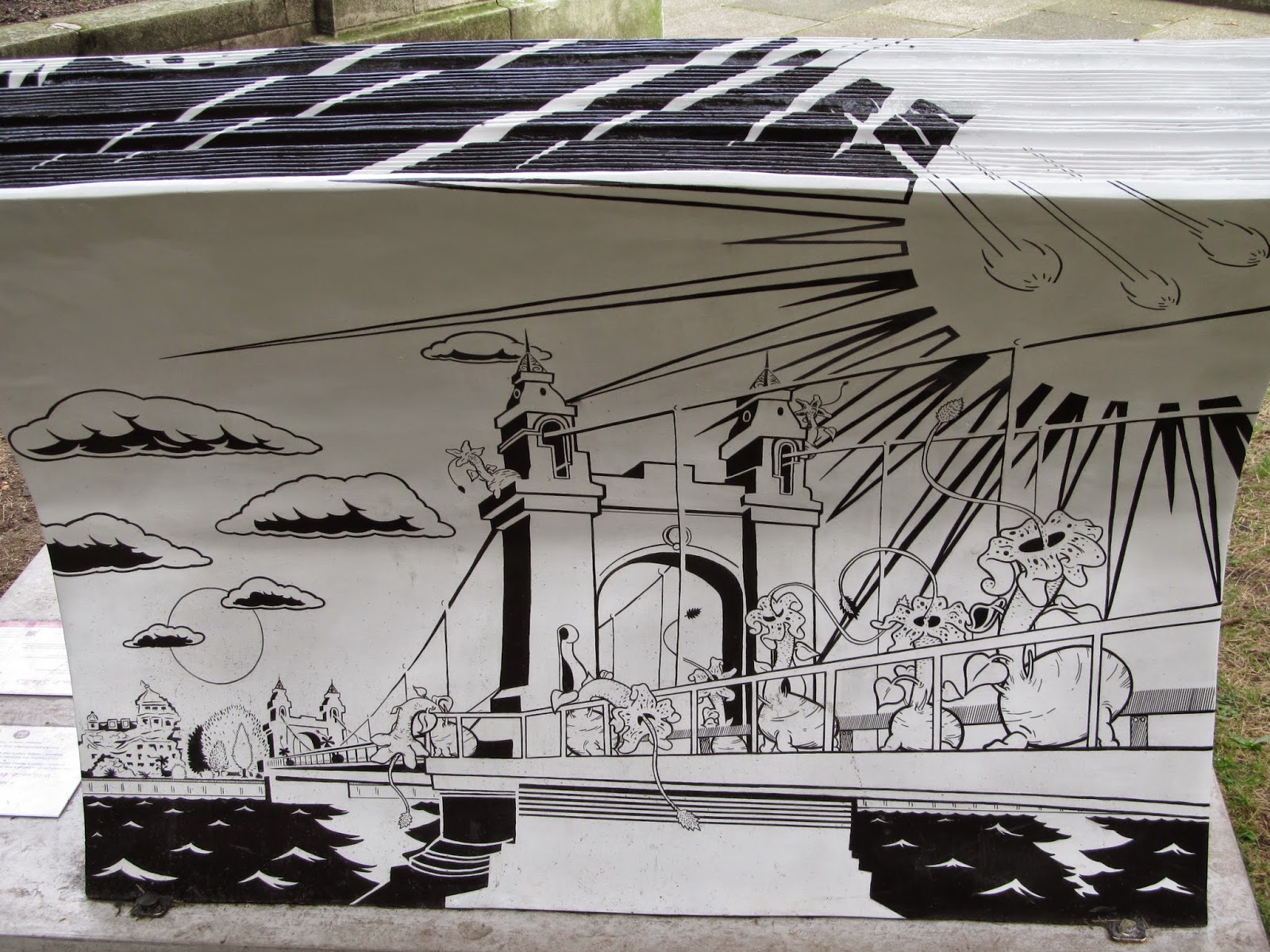

The back of the bench illustrating the Triffids and their gradual incursion into London.  A very lovely tribute to the brilliant novel, 'The Day of the Triffids' by John Wyndham.

Earnest (Bench 40 - 30th August 2014)
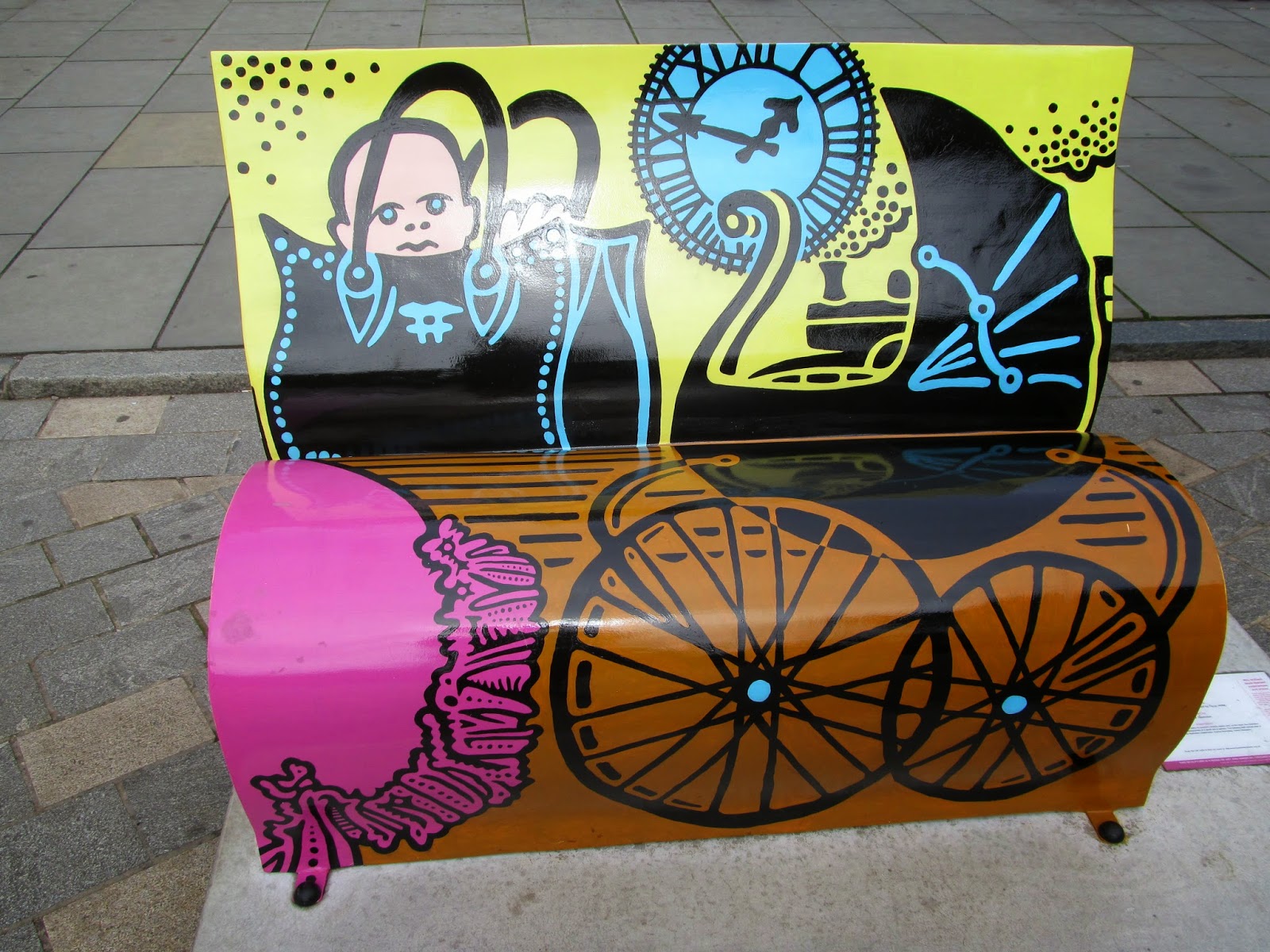

This very stylish and colourful bench was located in Byng Place.  Again, elements from the work that the bench was based on appear on this bench.  The front of the bench features prominent plot elements from Oscar Wilde's play, 'The Importance of Being Earnest', particularly note the child in the handbag.


The back of the bench which I believe plays on the concept of assuming various identities, in order to achieve your goals.  I love the striking and bold nature of this image.

The Curious Case of Sherlock Holmes (Bench 41 - 30th August 2014)


The front of the bench located in Woburn Square Garden.  There were works being completed the day I visited the bench.  This explains the odd angle.  Lots of Sherlock Holmes' references for you all to deduce.  Not least, the violin!  


The back of the bench seemingly picking up on keywords associated with Sherlock Holmes centred within the spines of other Sherlock Holmes' stories.

Mrs. Dalloway (Bench 42 - 30th August 2014)


The front of the bench rather austerely and delicately revealing the loves and fascinations of Mrs. Dalloway, Virginia Woolf's eponymous heroine.  I like the clock face in the background.  Time waits for no-one. 


The back of the bench which was located in Gordon Square Gardens.  For those in the know, the Woolfs lived in a property on Gordon Square from 1904 to 1907.  I initially did not think much of this bench.  It seemed too dark but it has grown on me.

1984 (Bench 43 - 30th August 2014)


The front of the bench which is quite simply stunning yet also too busy unless you are standing next to it.  'Nineteen Eighty-Four' is perfectly rendered.  It was located opposite Senate House between Malet Street and Torrington Square. 


The back of the bench which is just as busy.  Something about the style reminds me of Russian Expressionism and Cubism.  This was one of my favourite benches.  The automation and brutal order of day to day life perfectly shines through this bench.


Jeeves and Wooster (Bench 44 - 30th August 2014 (Back of bench) and 7th September 2014 (Front of bench))


The back of this bench based on P.G. Wodehouse's 'Jeeves and Wooster' stories.  The bench was located in the Brunswick Centre and needless to say, being a bench in a shopping centre around lunchtime, the possibility of getting a shot of both sides of the bench was pretty unlikely.  I managed to capture the back of the bench on 30th August 2014.  I did hang around the general area for a little while trying to capture the front of the bench but sadly, no luck on this occasion.  Jeeves serves his employer drinks, whilst he engages in a game of Croquet.


The front of the bench implying that someone can't handle his drink!  This photograph was taken on 7th September 2014.

The Lion, The Witch and The Wardrobe (Bench 45 - 30th August 2014)


The front of the bench depicting an event in C.S. Lewis' 'The Lion, The Witch and The Wardrobe'.  Narnia in all its cold beauty.


The back of the bench with a stunning representation of Aslan the Lion.  The bench was located in St George's Gardens.


The World's Biggest Flipbook (Bench 46 - 30th August 2014)


The front of the bench finally photographed on the 30th August 2014.  This bench was located underneath an escalator in Waterloo Station.  Another nightmarish bench to photograph.  People do like to sit!  The characters on the bench are the products of the imagination of Jeremy Banks, a cartoonist.


The back of the bench with some particularly charged graffiti including 'improved literacy'.  This bench is all about encouraging reading, as a means of progressing out of the sludge of everyday existence.  Notice all of the cartoon images of rubbish and the pigeons feeding on the waste of our consumer culture.

War Horse (Bench 47 - 31st August 2014)


The front of the bench containing elements from 'War Horse'.  The poppies are a particularly touching feature of the bench, which was located in More London Place (off of Tooley Street).


The back of the bench featuring the aftermath of war.

Around The World In Eighty Days (Bench 48 - 31st August 2014)


One of the very hidden benches.  This was located in Stanfords, the Travel bookshop in Long Acre.  Rather incongruously, it includes the London Eye, which wasn't featured in Jules Verne's classic.  Although, it's nice to see how the methods of transport used by Fogg and his companion are used on this bench.  See if you can spot the elephant.


The back of the bench effectively giving the plot of the novel in the style of a newspaper article.

Neverwhere (Bench 49 - 7th September 2014)


This bench was the very secret bench.  It was the last one added.  It was located in the Guardian Towers, next door to King's Place.  Unfortunately, when I visited the bench was right against the wall, so you could not see the back illustration.  As such, you can only see the front of the bench featuring characters from 'Neverwhere' by Neil Gaiman in my photograph.  You can see the back of the bench on various websites 
including http://www.theguardian.com/books/booksblog/gallery/2014/sep/12/neverwhere-book-bench-come-see-it-at-the-guardian.

Katie in London (Bench 50 - 7th September 2014)


The back of the bench located near to the Tower of London.  Although, this bench had a lot of activity.  It's interesting that people were content just to sit quickly then move on.  This of course was not the case with some of the other benches.  It's intriguing how some areas feel more conducive to sitting than others.  Anyhow, elements from 'Katie in London' by James Mayhew.


The front of the bench containing lots of London landmarks etc and an excited couple of kids riding a lion with a Union Flag.  

Noughts and Crosses (Bench 51 - 7th September 2014)


The front of the bench depicting elements from a series of books by Malorie Blackman set in a dystopian future.  The Noughts and Crosses being two disparate groups.


The back of the bench which was located in Fen Court.  Love in the shadows of chaos.  This was the last bench I photographed and I felt a certain sense of sadness as I walked away aware that I had finally accomplished what I had set out to do.

Afterword.

The benches and the characters, environments and ideas they represent are copyright to their respective artists and also to the authors upon whose works, most of the benches are based,

For more information on the auction that took place once the benches were removed and the prices that they gained at auction at the Southbank Centre on 7th October 2014, please see the following link:

http://www.booksabouttown.org.uk/?action=ViewPage&Id=9

The Guardian website link is of course, copyright to The Guardian.

                                                                            Barry Watt - 15th February 2015.


Sunday, 16 November 2014

The Great London Literary Bench Hunt Part 2

The second stage of my little hunt for Book Benches commenced on the morning of 3rd August 2014.  I decided to explore the Greenwich Trail.  My hunt ended up taking a couple of hours and I couldn't find three of the benches in Greenwich Park.  I vowed to find them at a later date as there is only so much fun to be gained in walking round in circles.  As I discovered from my previous hunt for benches, some of the benches were located in quite odd locations that did involve walking down random side streets.  Fortunately, the uniformity of the basic bench design made them slightly easier to locate, providing there weren't groups of people congregating around them as though they were sacred relics.

The Hitchhiker's Guide To The Galaxy (Planet 42) (Bench 15 - 3-8-2014)


This bench was located near to Greenwich Station and incorporated many elements from the best selling science fiction series written by Douglas Adams.  Please note Marvin the Paranoid Android contemplating life.  The bowl of flowers, fish and other elements also play important roles in the series.  This is the front of the bench and is the close relation of the back of the bench.


The back of the bench and of course, relevance is placed upon the number '42', which is the meaning of life, in case you had forgotten.

Dr. Johnson's Wild World (Bench 16 - 3-8-2014)


This was one of my favourite benches.  Samuel Johnson created one of the most influential dictionaries of the English language and this bench incorporated a large selection of words with their definitions explained both in words and in images.  For example, 'imagination' is illustrated by an image of a brain on fire and 'adultery' by a bed.  This bench was about a five minute walk from the Fan Museum.


The back of the bench illustrates Dr. Johnson at work on his dictionary.

On the Origin of Species (Bench 17 - 3-8-2014)


The front of the bench depicts the wonders of nature with the dodgy assumption that everything starts and ends with mankind.  Charles Darwin's evolutionary theories represented by a myriad of linked species.  This bench was in Greenwich Park.


The back of the bench reveals a spiral.  Quite a complex shape.  The spiral shape is a factor within the double helix of DNA.

Frozen in History - Journals: Captain Scott's Last Expedition (Bench 18 - 3-8-2014)


A bench with a very sad story attached to it.  Captain Scott's ill fated expedition to the Antarctic regions.  This bench was located near to the back of the National Maritime Museum.  The front of the bench is decidedly more upbeat than the back as it represents the earlier stages of the trip.


The back of the bench represents the end of the expedition.  The starvation and deaths caused by terrible weather conditions, preventing Captain Scott and his group from walking back to their depot, which was eleven miles away.  The six panels on the back of the bench reveal what happened.

The Jungle Book (Bench 19 - 3-8-2014)


A very colourful bench featuring many of the characters from Kipling's 'The Jungle Book'.  This was also in Greenwich Park.


The back of the bench representing the vast array of species that hang out in the jungle.

The Canterbury Tales (Bench 20 - 3-8-2014)


This bench was located near(ish) to the Royal Naval College.  Note the old English spellings of the place names.  Not the most exciting of the benches, although I enjoyed the typography.


Yes, the back of the bench.  If in doubt or if you can't think what to put on the back of  a Chaucer inspired bench, just paint it red.  Having said that, it does give the bench a sense of completeness.

The Railway Children (Bench 21 - 3-8-2014)


The front of the bench inspired by 'The Railway Children' by Edith Nesbit.  The iconic image of the daughter running to meet her father as he returns to the family after his mysterious disappearance.  This bench was located near to the River Thames and the Royal Naval College.


The back of the bench showing the train bringing the girl's father home.

Samuel Pepys' Diary (Bench 22 - 3-8-2014)


The front of the bench representing Pepys' diary and the Great Fire of London.  It's still amazing to think that at one point, a number of Londoners lived on a bridge.  This was near to the River Thames and the Royal Naval College.


The back of the bench with an illustration of Pepys writing his diary.

Girl Engrossed (Bench 23 - 3-8-2014)


The front of the bench depicting a girl laying on a sofa with the detritus of her age.  The most potent image is the copy of 'Adrian Mole' which inspired the bench


The back of the bench representing a girl reading.  I guess the girl may have been the artist remembering the past.  I can't remember exactly where this was, although it wasn't near the River Thames or the Royal Naval College.

The second part of the hunt for the Book Benches was slightly unsatisfactory as I failed to locate three benches in Greenwich Park, so I vowed to search for them at a later date.

Afterword.

The benches etc are copyright to their respective artists and owners.  Likewise, the books they represent are copyright to the authors and publishers etc.  For more information on the Book Benches, please see:

http://www.booksabouttown.org.uk/


                                                                               Barry Watt - 16th November 2014.


Saturday, 16 August 2014

The Great London Literary Bench Hunt Part 1

I am a sucker for a challenge.  I hasten to add that the challenge must be achievable and not require herculean feats of physical strength.  If we view our days retrospectively, we begin to learn that the systems and rituals we undertake or maintain allow little opportunity for novelty or improvement.  As such, breaking the patterns that dominate our lives, allow us to breathe a little more freely.

Enough of the prelude...  I was reading some publication or other and they made reference to fifty literary themed benches that were scattered around London and there was also a link to a website.  I mentally noted the website address and checked it out.  Thoughtfully, the website provides maps so that you can focus on certain areas to try find these benches (as I have discovered today, at least one or potentially two benches are not on these maps, so to get a complete list you need to look at the list of benches provided by the website).  The maps are the Greenwich Trail Map, the Bloomsbury Trail Map, the City Trail Map and the Riverside Trail Map.  I have no sense of direction, so the maps are quite useful although the 'BookBenches' as they are known on the site are not always easy to locate if you rely on the maps.  Certain benches are not on named roads or locations, so you have to rely on intuition and just plain guess work to find them.  As you may have gathered, I have decided to find all of the benches and also to photograph them.

The 'BookBenches' are part of a collaborative project between the National Literacy Trust and Wild In Art to encourage reading and also to suggest London's many literary connections.  For example, the so-called Bloomsbury Group used to live, study and work around the Bloomsbury area.  The Books about Town project will culminate with an auction of the 'BookBenches' on 7th October 2014 at the Southbank Centre and the money will be donated to the National Literacy Trust to encourage reading amongst disadvantaged children and young people around the UK.  The 'BookBenches' (hereafter known simply as benches in the blog entries on my bench hunt) have been in their respective locations since the 2nd July 2014 and will be there until 15th September 2014.  They have a uniform look, so if you are looking for them, their shape remains the same even though the art work that adorns them varies greatly, which makes the process of finding them more enjoyable.  Also the art work continues on the backs of the benches and on the sides.  As a quick aside, one of the pleasant aspects of finding the benches is to discover areas of London, you may not have seen or spent any time in.

I started my bench hunt on the 6th July 2014 as I had some time spare between visiting an art exhibition and going to see a film in the evening.  I armed myself with the City Trail Map and the Riverside Trail Map.  I was aware and continue to remain so that the geographical spread of the benches make it highly unlikely that you could find them all in one day unless your sense of direction is miraculous or you have someone with you who can smell the trails of the benches as a hunter may sniff the ground for traces of an animal's scent.  I lack both of these skills unfortunately.  Also it is more fun to focus on the areas.  I will let you know up front that I still haven't found them all as I haven't touched the Bloomsbury Trail Map and some of them I simply can't find (yet).  But I have found and photographed thirty one of them, so here are the ones I found on the 6th July 2014...  There is no particular order and the numbers I have allocated the benches is based simply on the order I photographed them.

Shakespeare's London (Bench Number 1) (Located near to the Globe Theatre, London)

Front of bench.  A pictorial depiction of the buildings that had some significance to the Bard.

Back of bench.  A representation of a London very different to the one we take for granted.  Bear in mind that properties used to exist on London Bridge.

That's Not My Meerkat (Actually titled Usborne's That's Not My... Bench (Bench Number Two) (Located very near to the Millennium Bridge and just before you get to St Paul's Cathedral)


Front of bench.  Wee Meerkats doing what they do.  Looking cute.

                                                        
                                                  Back of bench.  Panda eating whilst a little mouse looks on.  If you look 
                                                  closely you can spot the logo of the publishing house, Usborne (Hot air 
                                                  balloon in the corner).

Mary Poppins (Actually titled The Extraordinary East Wind) (Bench Number Three) (located near to St Paul's Cathedral)

Front of bench depicted the arrival of the eponymous Mary Poppins on the East Wind.


The back of the bench revealing some of the exciting things that happen in the novel.

Fever Pitch (Bench Number Four) (Located near to the previous bench and as such quite close to St Paul's Cathedral)

Front of bench and a representation of the opinion of the protagonist in Nick Hornby's novel.

Back of bench.  The importance of football to the main protagonist in the novel.

The Capital of the Imagination (Bench Number 5) (Located close to the previous two benches and once again, near to St Paul's Cathedral)

Front of bench.  Peter Pan and Tinkerbell flying over London.  I particularly like Peter's shadow.

Back of bench.  Peter Pan in Never Land.

The Jacqueline Wilson and Nick Sharratt BookBench (Bench Number Six) (Located very near to St Paul's Cathedral, not far from the previous three benches)

Back of bench with a child's leg inadvertently captured.  This bench is unsurprisingly
popular with children.  I can't help you with any of the characters' names.

Front of bench and photo taken very quickly prior to the arrival of yet more children.
I believe that the image on the right of the bench is a caricature of the author, Jacqueline Wilson.

Bridget Jones's Diary (Bench Number Seven) (Located somewhere in the region of Paternoster Square)


The front of the bench representing Bridget Jones doing what she does best, living for the moment and 
writing about her experiences and frustrations.


I guess the back of the bench is supposed to play up the romantic qualities of the novel.
Also reminds me of a playing card.

Regeneration - Dickens In Liverpool (Bench Number Eight) (Located near to St. Paul's Churchyard)

Dickens spent some time in Liverpool.  Very colourful bench designed by Hillside High School in Bootle.


Back of the bench focusing on aspects of Liverpool's cultural history in recent times.  Note the Superlambanana on the left hand side of the bench.

Brick Lane (Bench Number Nine) (Located in the Postman's Park or near there)

Front of the 'Brick Lane' bench.  Again includes elements of the novel.  Letters play an important part in the novel.

Back of bench.  Beautifully abstract portrayal of London and the novel and its characters.

The Laura Marlin Mysteries (Bench Number Ten) (Located in the very secluded and oddly beautiful Love Lane)

I know absolutely nothing about 'The Laura Marlin Mysteries'.  There is a very neat Joker card hidden in the foliage and rocks.

Back of the bench clearly journeying to the island depicted on the front of the bench.

Wisden - Wisden Cricketers' Almanack (Bench Number Eleven) (Guildhall)

Front of bench.  Lengthy quote on the bench, pertaining to the noble art of cricket (if you like that kind of thing).

Back of bench (taken from an odd angle as it is very close to a wall)

The Wind In The Willows (Bench Number Twelve) (Located near Bank)

Front of bench.  Again, beautifully done representing elements of the novel and pastoral scenes.

Back of bench with all of the lovely characters from the novel.

Alex Rider - Stormbreaker: The Graphic Novels (Bench Number Thirteen) (Located near Bank and close to the above bench)

Back of bench.  Not familiar with the source material.  Kid secret agent or something like that,

Quite snazzy front of bench.  Secret agents for kids.

Sit Here At Your Own Risk - A Brief History Of Time (Bench Number Fourteen) (Located near the Bank of England Museum (ish))

Very wild and amazingly eye catching representation of a black hole.

Back of bench.  Cosmic anomalies rock, don't they?

So this ends my first entry documenting my at times slightly frustrating hunt for the literary benches.  One area will become a new focal point if I require quiet time to reflect.  The area around the Guildhall, Barbican and the Museum of London is both an area out of time and also as potent as a good book.  I will find all of the benches even if I can't get all of the photos.  I am a man of my word.

Barry Watt - Saturday 16th August 2014.  

Afterword

Please check out www.booksabouttown.org for more information about the 'Book Benches' and the artists who have contributed their work.  Copyrights for all of the books etc belong to the authors, artists and publishers etc.

Please see the Wiki link for more information of the Superlambanana:

 http://en.wikipedia.org/wiki/Superlambanana

                                                                                                                                                                    B.W.


Sunday, 3 August 2014

The Interval or Intermission - Reclaiming the blank aesthetic space.

You know how it is...  You have been sitting watching a really good play then all of a sudden the lights go out and go on promptly and you are left with ten minutes to thirty minutes of your life to occupy in a manner that has some meaning (or not as the mood takes you).

Now, the theatres and cultural establishments have a myriad of reasons for encouraging these breaks.  Sometimes, they are necessary to change sets but mostly, the breaks are arbitrary; good excuses to encourage the audience to go out and buy drinks and over-priced ice creams. 

As you may have gathered, I am not a fan of intervals.  I have seen many a production lose its momentum as a result of this break.  Having said that, I do not seem to be alone.  If you gaze around the auditorium during the interval, lots of the audience members are sitting around, reading their programmes, dissecting the remnants of their lives in the electronic devices they choose to connect with at the expense of their souls.  I seem to be at the point of my life where celebrating the immediacy of the moment is very important.  Now just think what could be done with the time spent during the intervals.  People could actually talk about their experiences with each other.  You are all collectively watching a performance.  This is a shared experience.  Alternatively, a more subversive use of the interval could be devised.  For fun, you could jump up on stage or if you are slightly more conservative, stand in front of the stage, then recite either your own creative works or those of others.  Alternatively, just think of the stage as the equivalent of Speaker's Corner in Hyde Park, espouse rhetoric and radical theories at the captive audience, salivating at the prospect of the second half of the performance.  Personally, I like the idea of jumping on stage and moving the props.  Just think how excited the performers would be to return to the stage to discover that the book that eventually leads to the denouement of the narrative has disappeared. 

But on a serious note, I feel that it may be worth exploring the value of intervals.  They are the equivalent of Limbo or that little area next to the River Styx, where you wait for the Ferryman to take you off to the Underworld.  It is a space of dead time.  It can and has been used creatively, the most recent production of 'Mother Courage' at the National Theatre continued filling the interval with the sounds and actions of war as the stage was radically altered.  This production resonated even more owing to this attention to detail.  The never ending war continues even when the actors stop for a pee and a drink.

Reclaim the intervals, start using them as a springboard for creativity or social change.  The minutes add up and there is only so much time you can waste queueing at the bar (or for the toilets)!

Barry Watt - 3rd August 2014.

Afterword.

'Mother Courage (and Her Children)' was written by Bertolt Brecht and was last performed at the National Theatre in London in 2009 with Fiona Shaw and Duke Special.  A truly memorable performance.

                                                                                                                                   BW

Saturday, 26 July 2014

Shakespeare for Haters or Learning to Bear the Bard.

I first encountered Shakespeare as the result of a teacher at my primary school.  It was a typical assembly in a hall, like many school halls a wonderful symphony of odours, ranging from mashed potato to sweat.  The teacher gave us the rundown of 'The Merchant of Venice' and positively salivated as he relished the sound of the phrase, 'pound of flesh'.  He also explained to the innocents surrounding him, the only area where a pound of flesh could be removed (for your information around the heart).  Poor Antonio but you really shouldn't make deals with dodgy money lenders called Shylock...

The assembly remains etched upon my memories of childhood and to this day, I still haven't seen 'The Merchant of Venice' although I will.  The word 'flesh' makes me creep though, in this case owing to childhood fears and the associations made between 'flesh' and food consumption and cannibalism.  As I have subsequently learnt, Shakespeare touched on themes of cannibalism more than once in his plays.

It may not surprise you that Shakespeare and I as a child had little in common.  Indeed, even when I hit secondary school and studied 'Macbeth' at GCSE then 'Antony and Cleopatra' for A-Level.  It took a little while for me to get to grips with the subject matter and the language.  As an adult, I look back and I can resolutely empathise with students who cannot get on with Shakespeare.  His works mean so much more in performance than they do on the page.  The language is archaic, so it takes awhile to get to grips with the poetry of the works.  Slipping beneath layers of innuendo that wouldn't seem out of place in the 'Carry On' series years later to get to the real content of the works can be a tedious task for students.  Fortunately, my English teacher at secondary school had the sense to show the Polanski film of 'Macbeth', which also featured Keith Chegwin (children around the country will remember him as a TV presenter) and he sang.  'Antony and Cleopatra' worked for me once the power relations between the characters was established and let's face it, who can fail to love a play in which the lead bungles his own noble suicide.  I also studied 'Twelfth Night' for A-Level.  In retrospect, I prefer the tragedies to the comedies, they mean more to me, the characters are more real.  Although, 'Twelfth Night' does contain some amazingly funny characters and contains one of my favourite lines from Shakespeare, 'many a good hanging prevents a bad marriage' ('Twelfth Night Act 1, Scene 5).

When I resat A-Level English at college, I studied 'A Winter's Tale', which like many of Shakespeare's comedies involves mistaken identities, people hiding themselves under different disguises and some quite mundane comedy.  As I say, the tragedies are where Shakespeare excelled.  It's interesting to think that post college, Shakespeare and I did not really mix much.  I saw the odd production whilst I was at university but I was more interested in other playwrights.

It has only been recently that something about the Bard has struck home with me.  A friend suggested a lecture/performance piece at the British Library, which explored the notion that the clipped over the top BBC pronunciation of Shakespeare's works had removed it from its original context.  It was after all performed to everyone, not just to a group of upper middle class with more money than sense.  Also the actors came from a variety of backgrounds, so the dialect would of could alter how lines were delivered.  When you hear the work delivered in something that probably equated with the original pronunciation of the works, you can see the intricacies of the rhythmic structure and also as one of the actors stated, it changes how you deliver the lines.  The problem with trying to deliver the lines with too much austerity and too little emotion is to render them as passionate and appealing as a shopping list.  I have seen some truly average performances where somewhere beneath the dry expression of the poetry, there was once a brilliant play.

I can say now as an adult that I have a liking for Shakespeare and his works.  However, I will not deify his works.  I am not in the camp that feel that he should be studied at the exclusion of every other playwright or poet.  He should be seen in context.  At one point, I would have stated that you need to study his plays to get the most out of them.  Well, guess what?  I was only partially right.  It sometimes helps, but actually when you let yourself go and simply go to see lots of Shakespeare's plays, something changes.  You learn that they cover universal themes, that the characters are as familiar as your friends, family and enemies.  Also the language is as eclectic as the conversations you engage in with the people you encounter.  Sometimes, quite flowery, occasionally colloquial and always to the point.  I don't care whether Shakespeare wrote all of his own plays (logically, he may not have done, after all he worked in different theatre groups) but something about the works has started to resonate profoundly with me.  So much so, that I have vowed to see all of the plays I haven't seen performed professionally by the time I hit the age of fifty.

Shakespeare, I was wrong about you or maybe, I was led astray for a while and now I am back on track.

Barry Watt - 26th July 2014.

Afterword.

Roman Polanski's film, 'Macbeth' is available on DVD from Sony Pictures Home Entertainment.

Shakespeare's plays are available in a million different versions.  Just grab the ones you feel most comfortable with.  The family inherited a beautiful volume of Shakespeare's works with notes marking when the owner saw various productions and her opinions of the performances. She also drew a lovely image of the Bard.  The edition is 'Shakespeare's Works' (Oxford University Press 1928).  The line from 'Twelfth Night' was extracted from page 346 of this edition.


                                                                                                                                    BW